


Solitaire Real Money: Win Cash
Yalovarz LTD STI.
I approached Solitaire Real Money: Win Cash as a decision rather than a quick download: is this the right kind of solitaire for someone who wants a familiar card game with the possibility of cash rewards, or would a traditional, no-stakes version be a better fit? After spending time with its core idea, I found a game aimed at adults who already enjoy solitaire and want a more competitive reason to play. It is free to install, but the “free” label should not be confused with a completely consequence-free experience. The real question is whether the cash-focused format adds motivation or gets in the way of the calm, simple rhythm that makes solitaire appealing.
The game comes from Yalovarz LTD STI. It belongs to the card-game category and carries a Mature 17+ age rating, which immediately tells me it is not intended as a children’s pastime. Its store presentation focuses on playing solitaire and winning real cash, so I would not recommend treating it like an ordinary offline card app. That distinction matters when deciding who should use it, how much attention to give the reward element, and whether the familiar gameplay is enough to justify choosing this version over the many conventional alternatives.
How I Would Decide Whether It Fits
My first decision criterion is your reason for playing. If you want a quiet game for a few minutes while waiting for an appointment, a standard solitaire app may be the cleaner choice. If you like the idea of turning short card sessions into contests with a financial angle, this game is more relevant. The basic appeal is not a new card-game concept; it is the change in motivation. The cards remain recognizable, while the surrounding purpose becomes more competitive and reward-oriented.
The second criterion is your tolerance for uncertainty. A normal solitaire game gives you a predictable leisure activity: open it, play, finish, and close it. A real-money-focused game asks you to think more carefully about the difference between entertainment and financial expectation. I would only use it with a fixed personal limit for time and spending, if any spending is involved in the way the game presents its contests. That boundary keeps the app in the entertainment category instead of allowing the reward promise to control the session.
There is also a practical compatibility point. The listed minimum operating system is Android 5.1, so the game is positioned to work on older Android devices as well as newer ones. That is useful for people who keep an older phone for casual gaming. Still, operating-system compatibility does not guarantee that every device will feel equally comfortable. Solitaire depends on clear card layouts and accurate taps, so a small or aging screen can make a supposedly relaxing round feel needlessly fiddly.
Related News






I also look at trust signals without treating them as proof that every player will have the same experience. The game has an average rating of 4.6 from around 46 thousand ratings, along with roughly 3.5 thousand written reviews. It has passed the 100-thousand-install mark, which suggests that the concept has attracted a meaningful audience. Those figures make me more willing to investigate it, but they do not replace my own rule: never play for money that I would be uncomfortable losing, and never assume a favorable rating guarantees a particular result.
The familiar card format is the main advantage
Where this product wins is accessibility. Solitaire has a much gentler learning curve than many competitive card games. I do not need to memorize a large collection of special cards, build a complicated deck, or learn a long sequence of controls before starting. That makes the game easy to pick up during a short break. The real-money angle may attract someone who has already become bored with ordinary solitaire, while the underlying card format keeps the barrier to entry low.
I can also see the appeal for players who need a repeatable routine. A short session can fit into a commute, a waiting room, or the few minutes before bed, provided the reward aspect does not encourage playing longer than intended. In that situation, the app works best when I decide in advance what a session means: perhaps one brief round, followed by closing the game regardless of the result. That simple habit is more useful than chasing a win after an unlucky hand.
Gallery
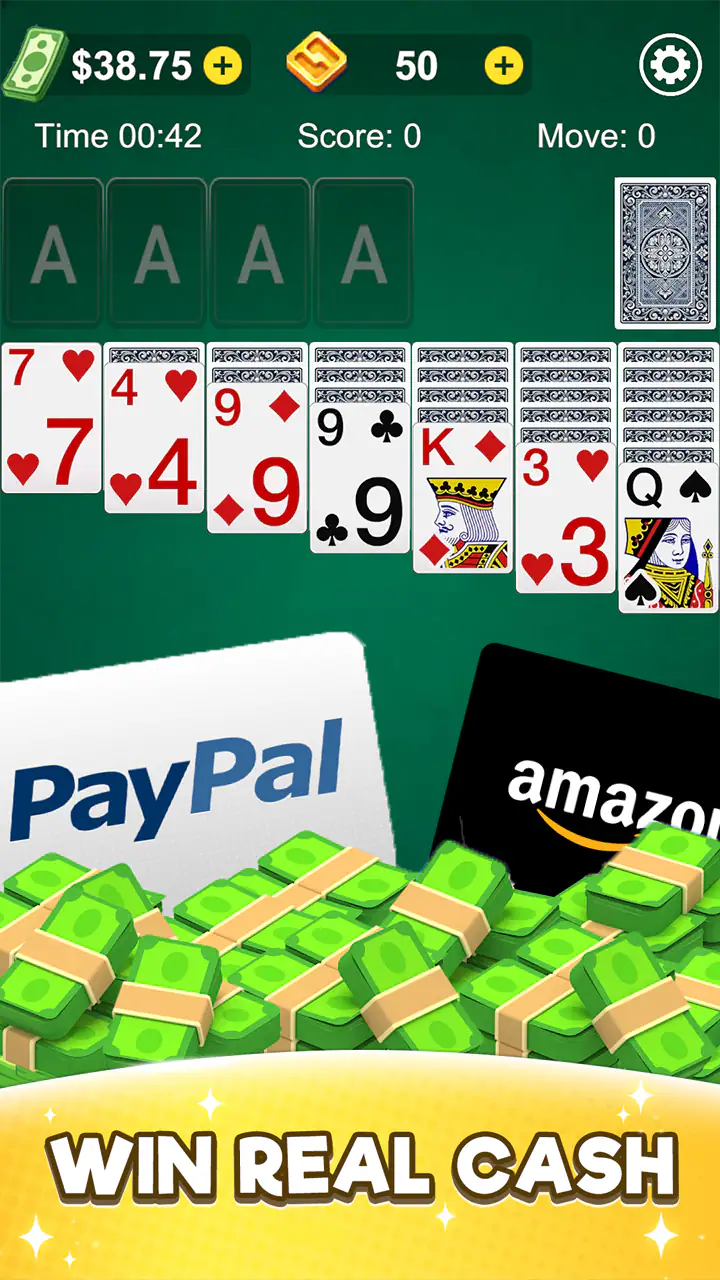
Another strength is the clear identity of the product. It is not pretending to be a broad card-game collection. The focus is solitaire with real-cash motivation. For a player who specifically searches for that combination, the app is easier to evaluate than a general gaming platform filled with unrelated modes. I know what kind of experience I am opening, and the mature rating reinforces that it is designed for adults rather than family play.
My most useful practical tip is to judge the app by the quality of the session, not by the promise of the outcome. Before starting, I would check whether I am playing because I genuinely want a solitaire round or because I feel pressure to recover a previous result. That distinction is easy to miss with reward-based games. If the second reason becomes common, the app is no longer serving the purpose I wanted from it, and taking a break is the sensible move.
Small-session planning matters more here than in ordinary solitaire
With a conventional solitaire app, leaving mid-session usually costs nothing beyond losing your place. In a cash-oriented setting, I would be more deliberate. I would avoid opening a contest when I know I may be interrupted, when my connection or attention is unreliable, or when I am already tired. A distracted player can make poor decisions even in a familiar card layout, and the financial framing makes that distraction more important.
I would also keep the game separate from essential phone activities. Notifications, messages, and quick task switching can turn a five-minute card break into an unfocused session. My preferred workflow would be simple: choose a time window, play only while I am alert, and stop at the planned endpoint. This is not a feature claim about the app; it is the way I would use this particular type of game responsibly.
For people sharing a device with younger family members, the Mature 17+ label is especially relevant. I would not hand the phone over casually or present the game as a harmless children’s card activity. The cash component changes the conversation, even though the underlying game is familiar. Adults who want a family-friendly solitaire experience should choose a version built around ordinary play instead.
What the version and release timing suggest for a cautious user
The current version is 1.2, and the game was released on September 29, 2025. Because it is a relatively early version, I would approach it with the expectations I use for a newer app: explore the main flow first, avoid assuming that every edge case will feel polished, and pay attention to how clearly the game explains its reward-related steps. A low version number is not automatically a flaw, but it makes patience more valuable than blind confidence.
That is also why I would not make a large commitment immediately. I would begin by learning the basic play loop, understanding what a session asks me to do, and deciding whether the interface feels comfortable. Only after that would I consider whether the reward format is worth continuing. The best early test is not whether I win; it is whether I understand what is happening at every stage without feeling rushed or confused.
When a Traditional Alternative Is the Better Choice
Solitaire Real Money: Win Cash is not the obvious choice for everyone. If your main goal is relaxation, concentration, or passing time without any financial pressure, a standard solitaire game may be better. Traditional alternatives usually make the activity feel more private and self-contained: there is no need to think about rewards, contests, or the possibility that a casual round has more at stake than expected.
A no-stakes version is also preferable for children, for adults who are trying to avoid gambling-style motivation, and for anyone who tends to continue playing after deciding to stop. I would skip this game if I knew that a losing result would make me immediately start another session to prove I could reverse it. Solitaire should remain a pleasant mental break, not a test of persistence against an emotional reaction.
Other card-game categories may fit better if you want deeper strategy. A collectible card game, a deck-building game, or a multiplayer strategy title can offer more control over long-term decisions than a familiar solitaire structure. Those alternatives may require more learning, but they can be more satisfying for players who want progression, planning, or direct competition rather than quick rounds.
On the other hand, a conventional solitaire app may feel too passive for someone who has stopped playing because there is no sense of purpose. That is the specific space this game occupies. The cash-oriented framing can make a familiar activity feel more urgent and give experienced solitaire players a reason to return. Whether that is a benefit depends entirely on how you respond to competition and rewards.
The cost of switching is relatively low in terms of learning. Someone moving from ordinary solitaire should understand the card logic quickly, so there is no major skill barrier. The bigger cost is behavioral: once rewards enter the picture, it can become harder to treat each round as disposable entertainment. Moving back to a no-stakes alternative may feel less exciting, but it can restore the calm rhythm that originally made solitaire attractive.
There is also a cost in attention. If you compare this game with a basic solitaire app, you are not only comparing card layouts. You are comparing two different mental contracts. One says, “play for yourself.” The other says, “play within a reward-focused environment.” I would choose the first when I want rest and the second only when I actively want that extra layer and can keep it under control.
Questions I would settle before continuing
A reader may reasonably wonder whether the app is truly free. It is listed as free, which makes trying the basic download straightforward, but the cash-focused purpose means I would read every in-game instruction carefully before committing anything. “Free to install” and “no financial considerations at all” are not the same statement, so I would never tap through a contest or transaction screen without understanding it first.
You may also ask whether you need to be an expert at solitaire. I do not think so. The familiar card format is approachable, and the game is more suitable for people who already know the basic rules or are willing to learn them than for players seeking a complex new card system. Beginners should start slowly and focus on understanding the layout rather than trying to optimize immediately for a reward.
Another practical question is whether it suits quick breaks. Yes, that is one of its more natural use cases, but only if you can stop cleanly. I would not start a round when I have to leave in a minute or when I am likely to be interrupted. A short, planned session is a good fit; an open-ended attempt to keep playing until the result feels satisfying is much less appealing.
People may also wonder whether the cash element makes it a good replacement for every solitaire app. In my view, no. It replaces a standard version only for adults who specifically want reward-driven play. It is not a universal upgrade, because the same element that attracts one player can make another player uncomfortable or distracted. The right comparison is not “which app has more features?” but “which kind of motivation do I want while playing cards?”
Finally, I would ask whether the game is suitable for an older Android phone. The minimum requirement of Android 5.1 gives it a broad compatibility starting point, which is encouraging. Even so, I would test the card readability and touch response on the actual device before settling in. Solitaire is visually simple, but accurate selection matters, and a cramped screen can undermine the experience more than an ambitious feature list would suggest.
My recommendation for different kinds of players
I recommend trying it if you are an adult solitaire fan who wants a more competitive, reward-centered reason to play and who can set firm limits around time and money. The free entry point makes an initial look easy, while the strong average rating and growing install base suggest that the idea has found an audience. I would treat those signals as an invitation to test the experience, not as a promise of personal winnings.
I would recommend skipping it if you want a completely pressure-free card game, if you are under the Mature 17+ age threshold, or if financial rewards tend to make you chase losses or extend sessions. In those cases, an ordinary solitaire app is the better decision, even if it feels less exciting. A simpler alternative can be more enjoyable when it matches your actual reason for opening the game.
My own approach would be cautious and practical: install it, learn the basic flow without rushing, decide on a session limit, and stop if the reward element becomes more important than the solitaire itself. That gives the game a fair test while protecting the part of the experience that should remain enjoyable. The best reason to choose this game is controlled, adult entertainment—not the expectation of easy money.
Overall, Yalovarz LTD STI has built a focused card game for a specific audience rather than a universally suitable solitaire replacement. Its strongest point is the familiar format paired with a cash-oriented purpose, making short sessions feel more consequential for players who want that. Its main limitation is the same feature: the financial framing demands more judgment than ordinary solitaire. For the right adult player, it is worth exploring; for everyone else, the traditional alternative is likely the wiser and more relaxing choice.
FAQs for Solitaire Real Money: Win Cash
What is Solitaire Real Money: Win Cash?
Solitaire Real Money: Win Cash is a mobile card game based on classic solitaire gameplay, usually presented with competitive tournaments, challenges, or cash-prize opportunities. Players complete deals, score points, and may compete against other users or timed targets. The exact availability of cash contests, rewards, and game modes can depend on your location, age, device, and the current version of the app.
Can I really win real money by playing Solitaire Real Money: Win Cash?
The app may offer opportunities to win cash or other rewards through eligible competitions, but winnings are not guaranteed. Results can depend on your performance, the rules of each contest, entry requirements, and the number of competing players. Before depositing money or joining a paid tournament, carefully review the prize terms, fees, withdrawal conditions, and any restrictions that apply in your country.
Is Solitaire Real Money: Win Cash free to download and play?
The application may be free to download, but some features can include optional purchases, paid tournament entries, advertisements, or other in-app charges. Free modes may be available for practicing solitaire without risking money, while cash competitions can require an entry fee. Check the store listing and the in-game payment screens carefully so you understand when real money is involved.
How do withdrawals and cash rewards work in the app?
Withdrawal procedures can vary according to the app version, your region, and the payment methods supported by the developer. You may need to meet a minimum balance, verify your identity, and use an approved payment account before requesting a payout. Processing times, service fees, taxes, and eligibility rules may also apply, so read the withdrawal policy before playing for cash.
Is Solitaire Real Money: Win Cash safe and suitable for everyone?
The game may be suitable for adults who enjoy solitaire and understand the risks associated with competitive cash gaming, but it is not necessarily appropriate for children. Availability and legal requirements differ by location, and some contests may involve financial risk. Download it only from an official app store, review permissions and privacy information, set a spending limit, and avoid treating potential winnings as guaranteed income.
Pros
- Familiar solitaire gameplay that is easy to learn and play casually.
- Quick matches fit well into short breaks or commutes.
- Competitive leaderboards can add motivation for skilled players.
- Smooth card controls make moving and arranging cards feel intuitive.
- Cash prizes may appeal to players seeking rewards for their gameplay.
Cons
- Real-money contests may not be available in every country or region.
- Withdrawals can involve eligibility rules
- verification
- or processing delays.
- Results may depend partly on card distribution
- not just player skill.
- Frequent ads or promotional offers may interrupt the free-play experience.
- Players should monitor spending
- as entry fees can accumulate over time.


